
Advance Gracefully with AI Hospitality
HotelGPT is your AI-powered virtual hotel manager, operating globally with intelligent chatbots.
Why you should use HotelGPT?
Many hotel guests complain about communication problems. First of all, it is the language barrier. The variety of languages and accents makes communication between a guest and the hotel staff sometimes extremely difficult. And the staff themselves cannot always answer the questions of the guests quickly and accurately.
We analyzed 500 hotel guest reviews (4 and 5 star hotels) to explore the main reasons for possible dissatisfaction with the service (reviews on Booking.com, Agoda.com and Google Maps were considered). Also, We interviewed 100 people anonymously who travel at least 2-3 times a year and stay in 4 and 5 star hotels*
Here are the results of our research:
30% of guests who use chatbots to communicate with the hotel spend so much more money.
16.9% of guests are dissatisfied with the response of hotel staff to complaints/inquiries.
28.5% – almost 1/3 of guests complain about inattentive/rude staff.
5.3% face difficulties caused by the language barrier.
We have developed a solution that will help to solve any guests’s problem and dramaticaly increase their user experience. It will allow to reach a new level of interaction with the guests. Let’s see how it works:
Hotelgpt demo video
Informing guests about hotel services:
When a guest needs to know something, he simply asks a question in his native language in his favorite messenger and instantly receives a correct and comprehensive answer in the same language.
Chatbots are constantly being trained, so even if the system does not know the correct answer, it will translate the question into English and redirect it to the reception. And remember the answer.
The hotel staff themselves can change the necessary information or add a new one in minutes. You can attach a picture or video to the answer, for example, a building’s map or a menu.
Processing and transfer of guest requests:
When a guest needs help, or he wants to get some kind of service, make an order – he just clicks a button in the chatbot and writes or says in his native language what exactly he needs.
The system processes his request, determines which department it belongs to (reception, room service, laundry, restaurants, parking/taxi department), translates it into English and sends it to the department’s personal account and immediately informs the department’s employees by messenger.
ou can attach a photo to the request, for example, when ordering food, you can simply take a picture of part of the menu. An employee can clarify the information by writing in English in his personal account. His response will be translated back into the user’s language and redirected to him.
All dialogs are stored anonymized, as is the reaction time of each employee. Subsequently, you can make a report and analyze the work of each employee, the response time, the level of guest satisfaction with services.
Urgent distribution of informational messages:
In the personal account, staff member can prepare a message, attach an image if necessary and send a message either to all guests who currently live in the hotel or only to selected ones.
After the guest has left the hotel, you can conduct a short survey about his impressions and wish him a safe journey.
Another important way to use the newsletter is to remind the user about his visit to the hotel, for example, after 10 months and invite him to visit the hotel in the new season again.
Sales bot for the hotel website:
Another implementation of HOTELGPT is a widget that can be placed on the hotel’s website. Unlike the usual functionality, here HOTELGPT is designed to answer questions from potential guests who are still deciding whether they want to stay at the hotel.
This option is an alternative to communicating via the booking message system or via email. The obvious advantages over these communication methods are that HOTELGPT responds accurately and instantly.
Let’s describe in more detail the process of using HotelGPT on the part of the guest
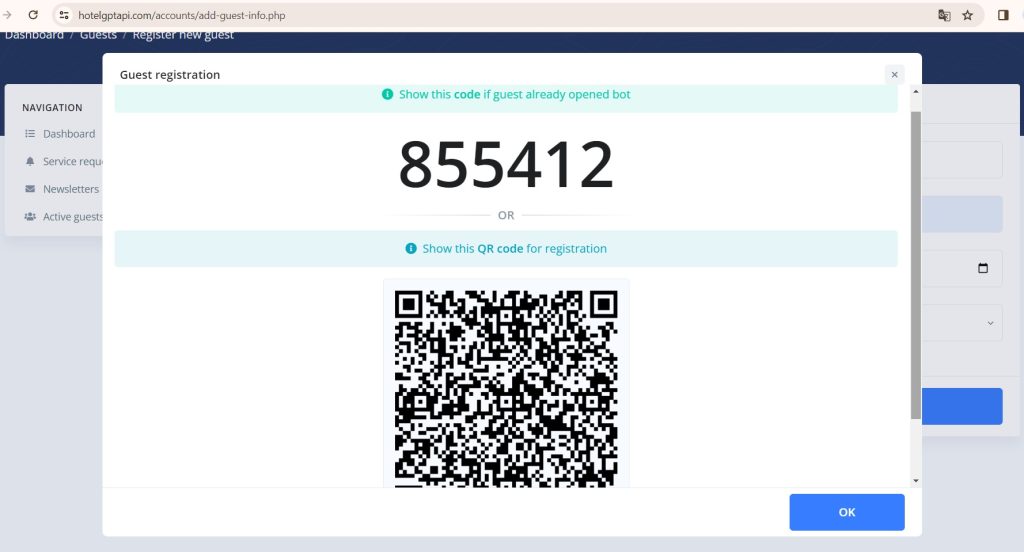
When checking-in, the reception staff fills the guest’s info in the account: name, number, check-out date and preferred messenger. HotelGPT generates an individual QR code and a unique number.
There are two ways to authenticate a guest:
·If the hotel has the technical ability to show the generated QR to the guest, for example, there are monitors at the reception, then the guest scans on the QR and immediately begins a dialogue.
·The second option is a static QR code, which can be printed on paper or displayed on a large screen. When using it, the guest will choose the messenger himself, after which HotelGPT requests a unique number. By entering it, the guest gets into a dialogue.
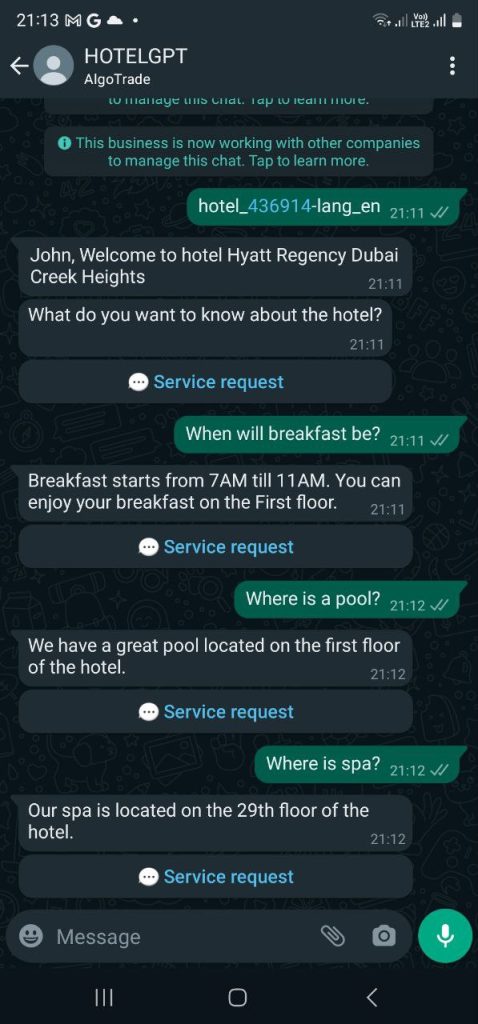
After that, he can freely speak native language with the bot and ask any questions about the hotel’s services.
The exact answer will be given almost instantly in the language of the request and it is difficult to understand that communication is not with a living person.
The guest can use not only text, but also voice. Hotel GPT will automatically detect the language of the request, recognize the question and respond.
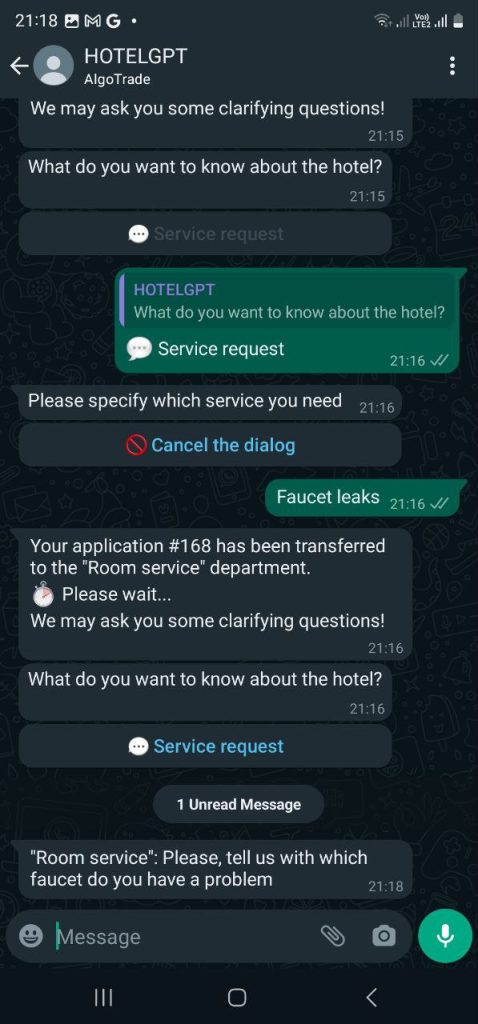
If a guest wants to ask for something, make an order or complain, he simply clicks the “Service request” button and writes his request in native language.
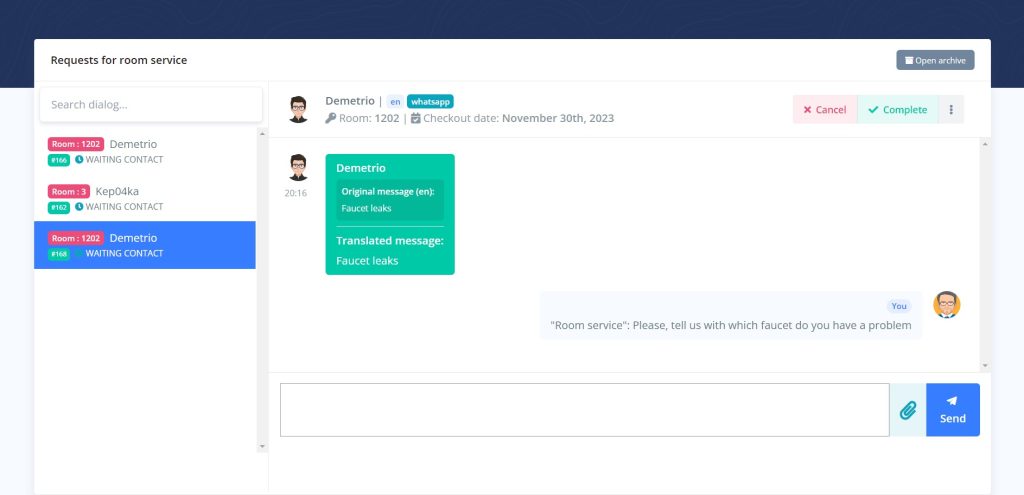
The system automatically determines which department the request belongs to. After that, the request is translated into English and gets into the personal account of all employees of the relevant department. Also, they receive a notification in the messenger
A hotel employee opens his personal account and sees a list of all requests that relate to his department. Currently, the following departments are defined:
- Reception,
- Room Service,
- Food Ordering,
- Taxi and Car Service,
- Laundry Service.
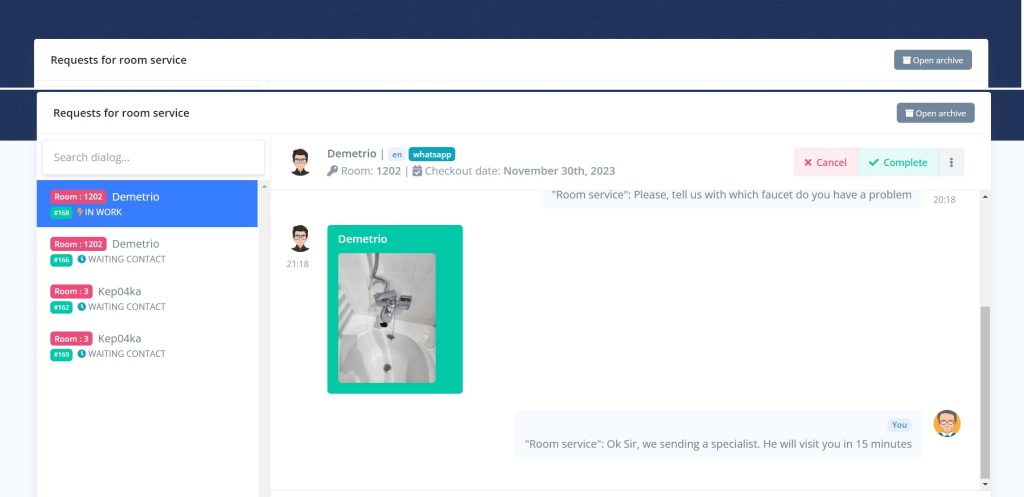
n this example case, the guest asked to change the towels and did it in Russian.The guest asks the staff to do it within an hour, to which the employee replies that I will bring towels in 15 minutes and closes the dialogue.
After opening the message, staff can clarify something with the guest, in our case, ask when he would need towels.This message is translated back into the user’s language and sent to him.
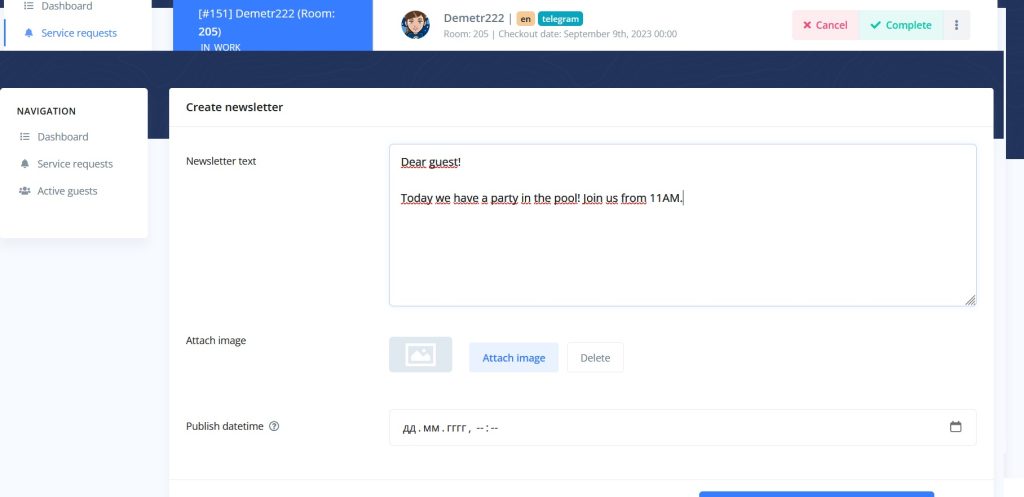
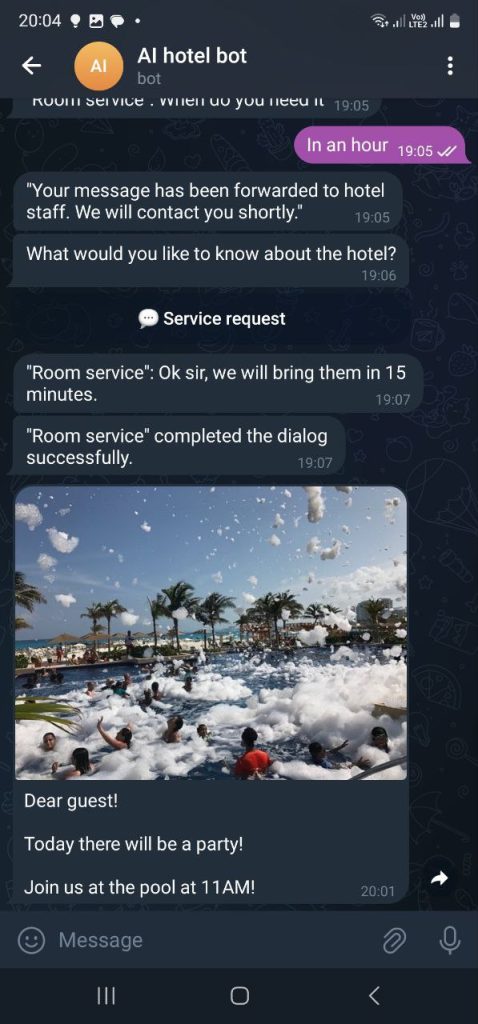
n the staff personal account, it is also possible to send informational messages to all active guests (that is, those who have not yet left) by attaching images to the message. You can also schedule messages to be sent at a certain time.
For example, we invited all the guests to a pool party.
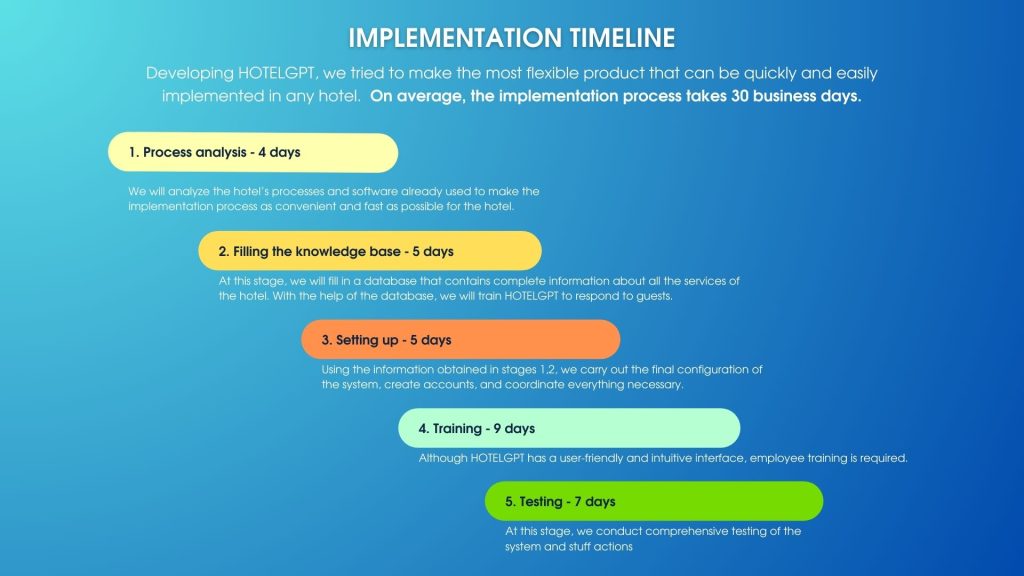
The implementation of HotelGPT in your hotel will take only 30 days
Take Your Business to the Next Level
Quantum Leap Solutions: Innovative software solutions for businesses. Stay ahead in the digital era. Contact us to achieve your goals.